Q-Flow
A pitch for hybrid quantum-classical logistics optimization, built by a team of four for the Qiskit Fall Fest 2026 (IBM Quantum + FIAP).



The Product
Q-Flow is a B2B SaaS concept for freight carriers. It connects to the transport management system (TMS) a carrier already uses and plans routes, vehicles and schedules together, instead of one at a time. The team built a working proof of concept and ran it on real IBM quantum computers. My part was the product and the pitch.
Product Designer
Hackathon (Nov 2026)
What this project achieved
Turned an abstract optimization method into a product a carrier could adopt: an API on top of its TMS, explained through a two-truck example.
The team delivered a 19-slide deck, a narrated 2:54 pitch video and a proof of concept run on IBM Kingston and IBM Fez, presented with its limits stated.
The Problem
Routes, vehicles, loads, schedules and refueling are separate decisions, but they depend on each other: changing one route changes the cost of all the others. With 30 yes-or-no decisions there are already more than a billion combinations.
In practice these decisions are made one at a time, in the TMS or in a spreadsheet, so the cost of the interaction between them stays invisible. The shortest route is not always the cheapest: load, slope, fuel prices and two trucks on the same road all change the real cost.
My Contribution
- Shaped the product proposal: an API layer on top of the TMS the carrier already uses, not a replacement for it
- Wrote the pitch script, a story from noise to plan told in under three minutes
- Built the explanation around a two-truck example, so the method reads without a physics background
- Designed the visual identity and the slides used in the deck and in the pitch video
- Recorded the narration and edited the 2:54 pitch video, syncing each sentence with its subtitle and chapter
The Deck
A 19-slide deck and a narrated pitch video. The slides are in Portuguese, the language of the competition.
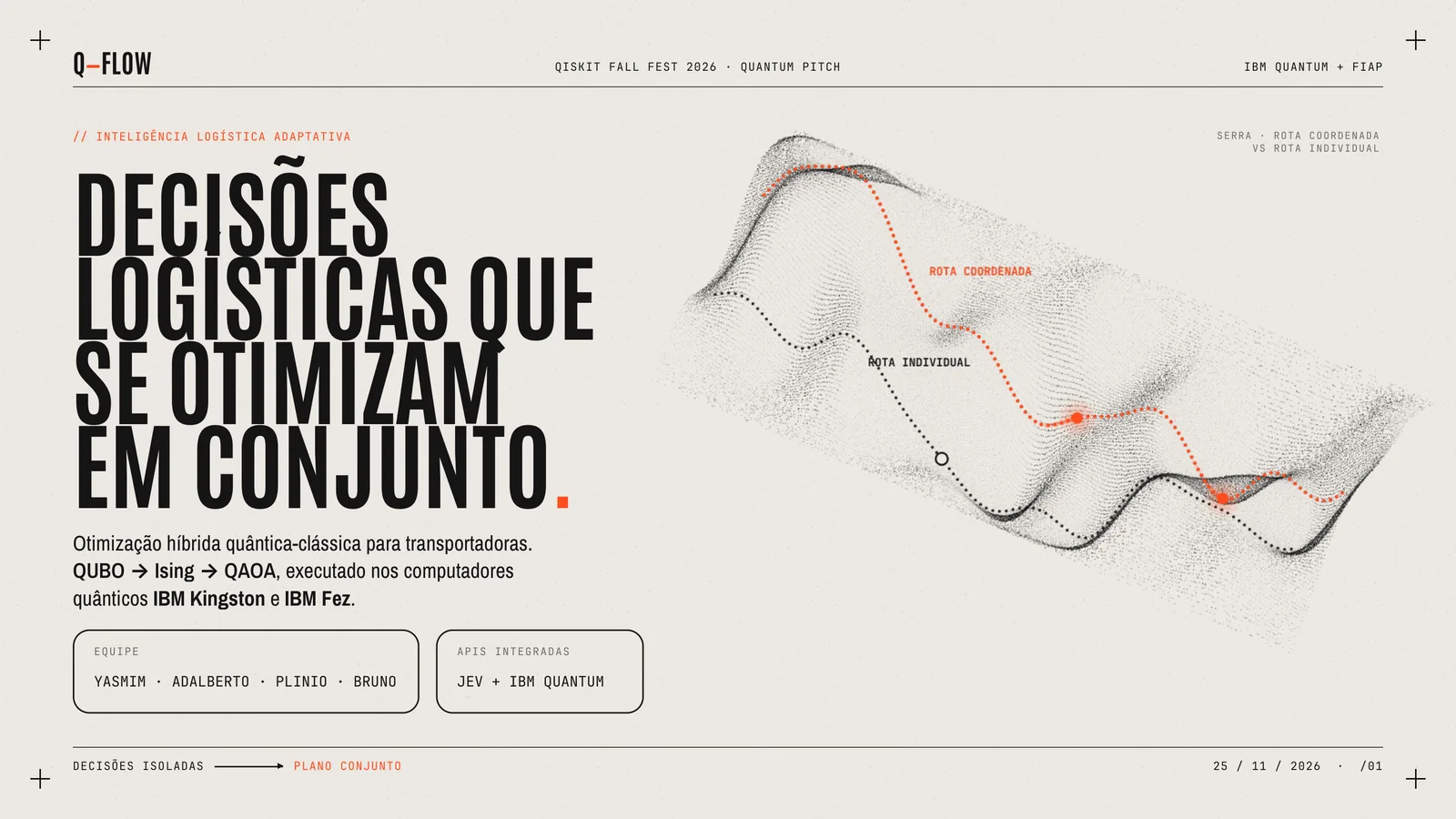
Cover: logistics decisions that optimize together

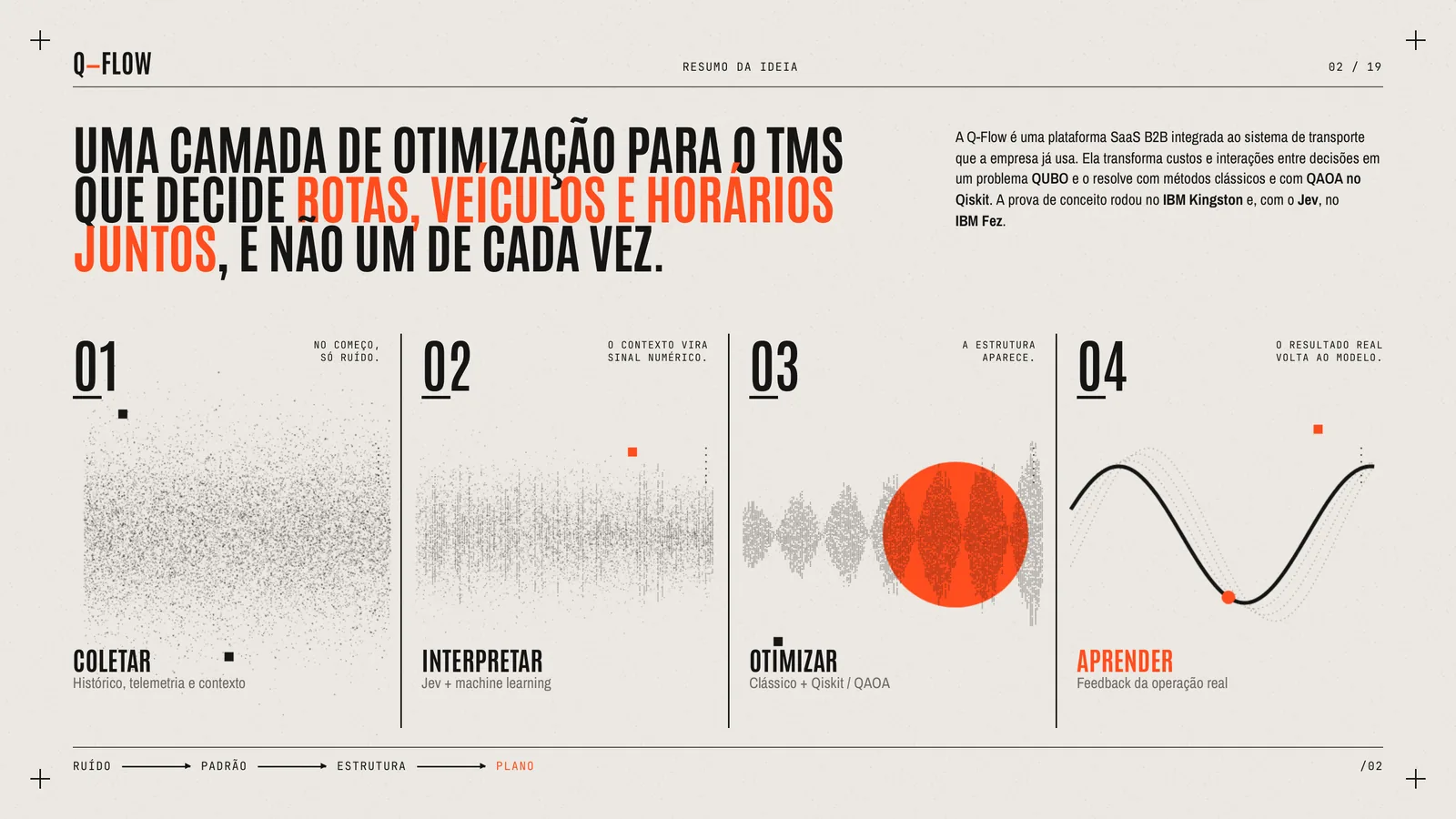
The idea in four steps: collect, interpret, optimize, learn

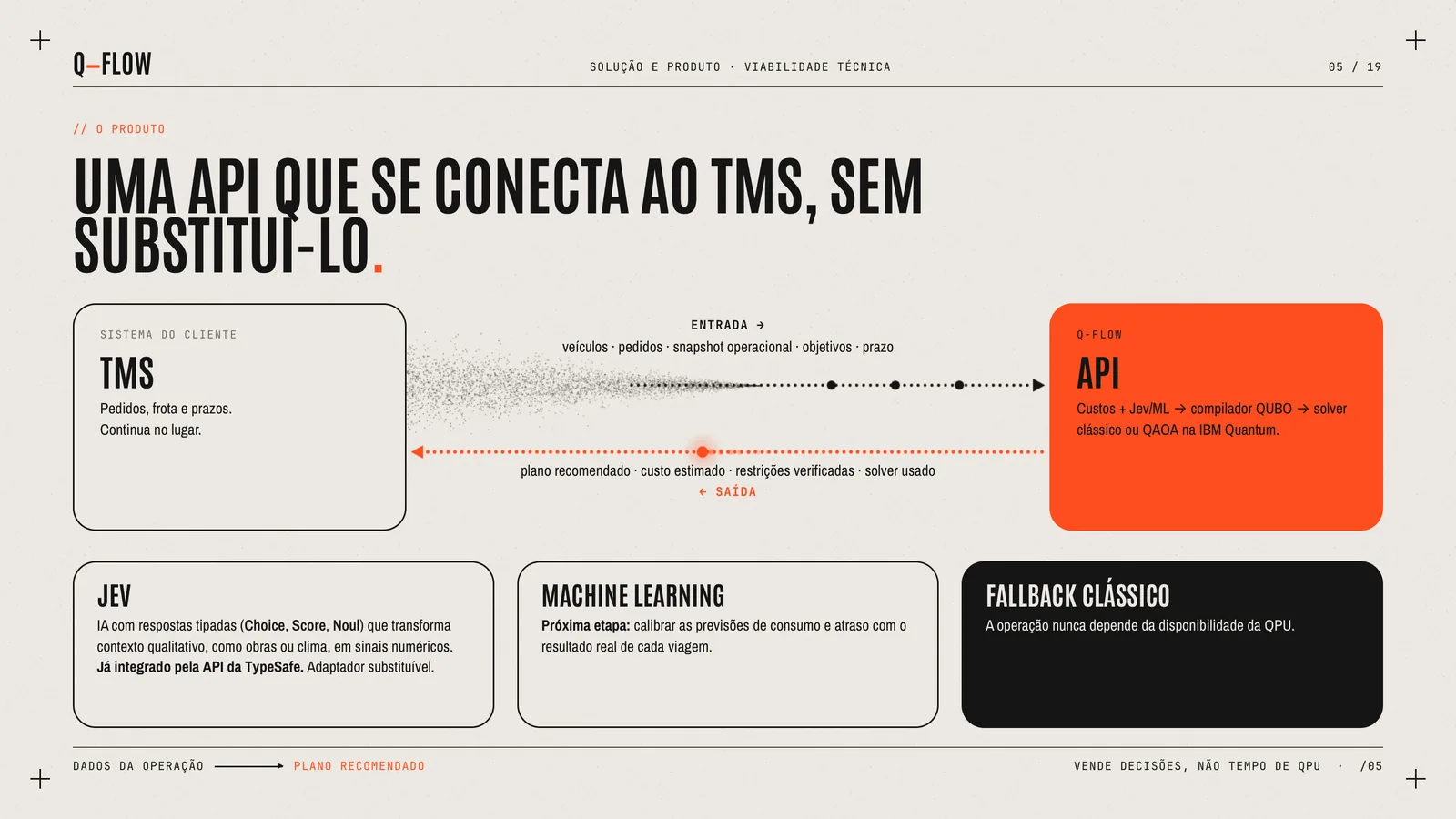
The product: an API that connects to the TMS without replacing it
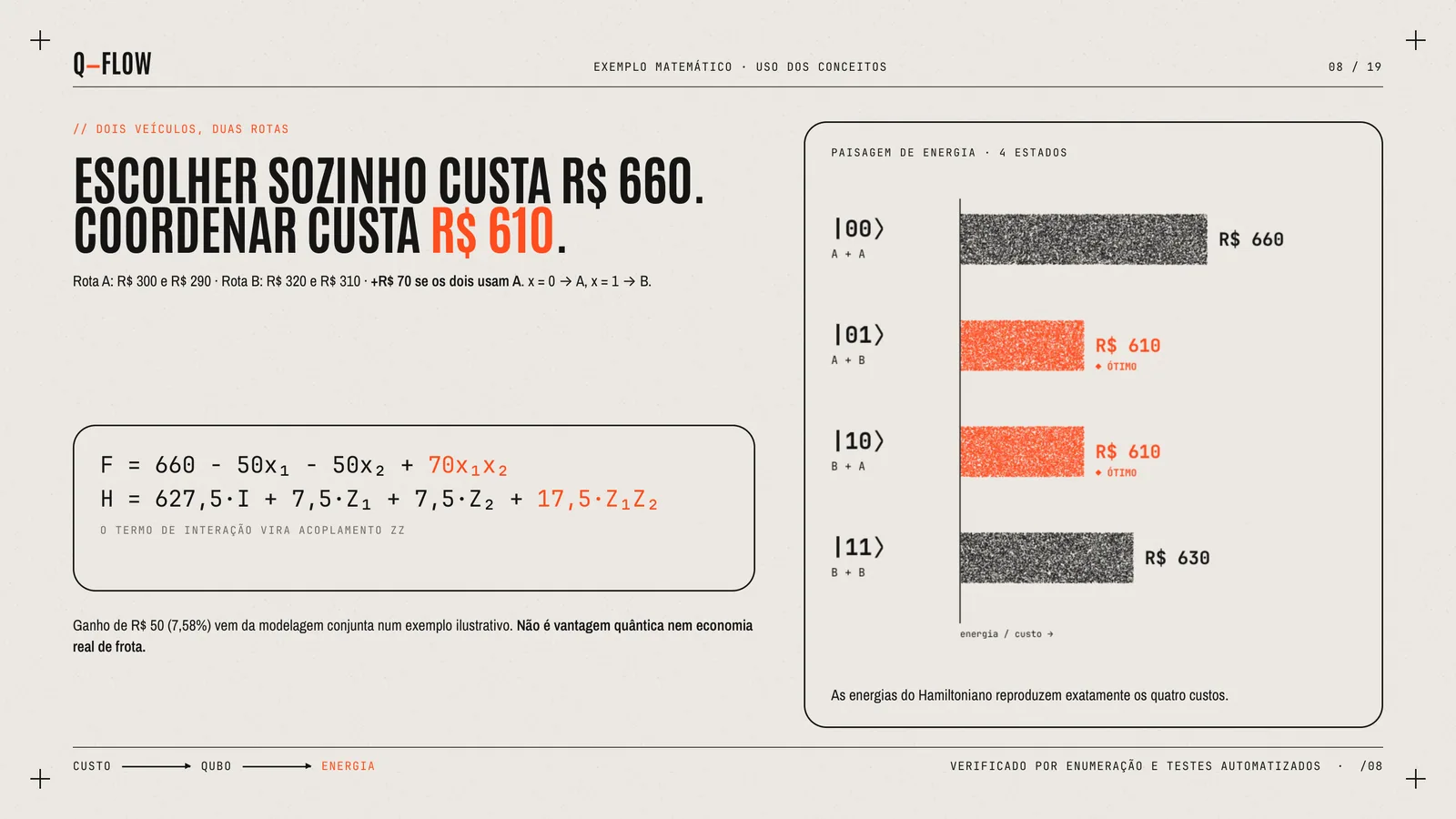
Two trucks, two routes: deciding alone costs R$ 660, coordinating costs R$ 610
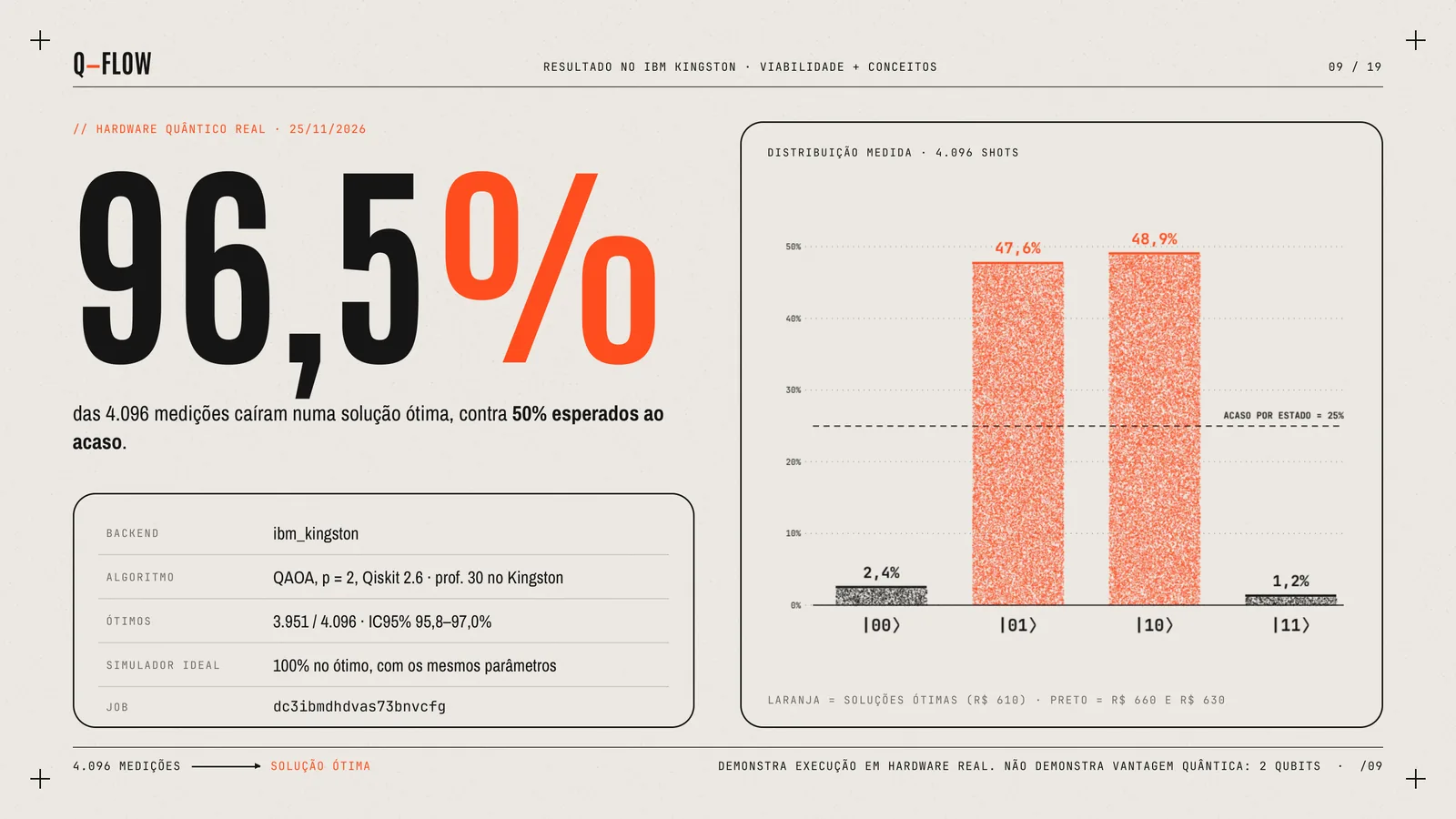
IBM Kingston: 96.5% of 4,096 shots on an optimal solution, against 50% by chance

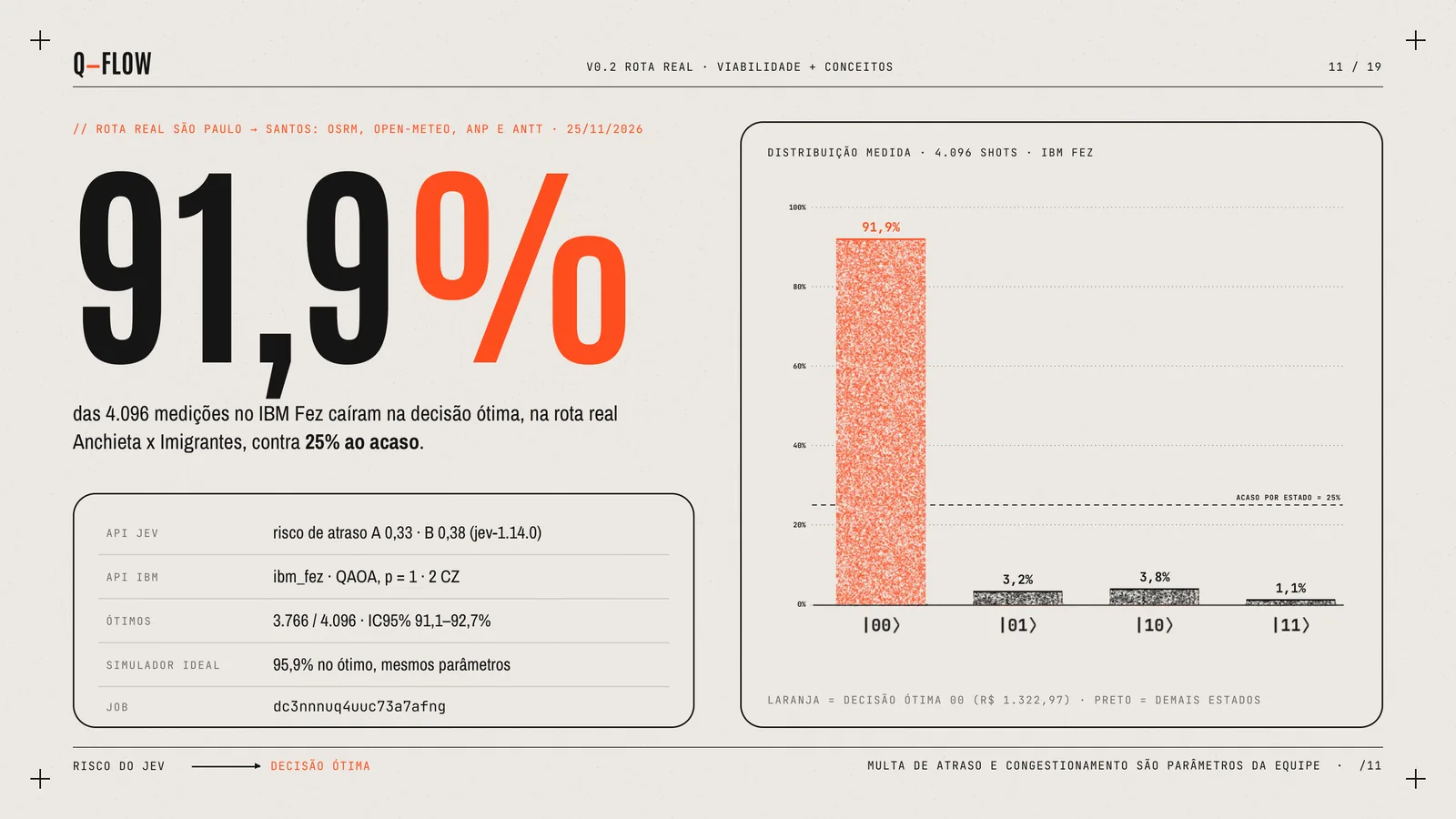
Real São Paulo to Santos route on IBM Fez: 91.9% on the optimal decision, against 25% by chance

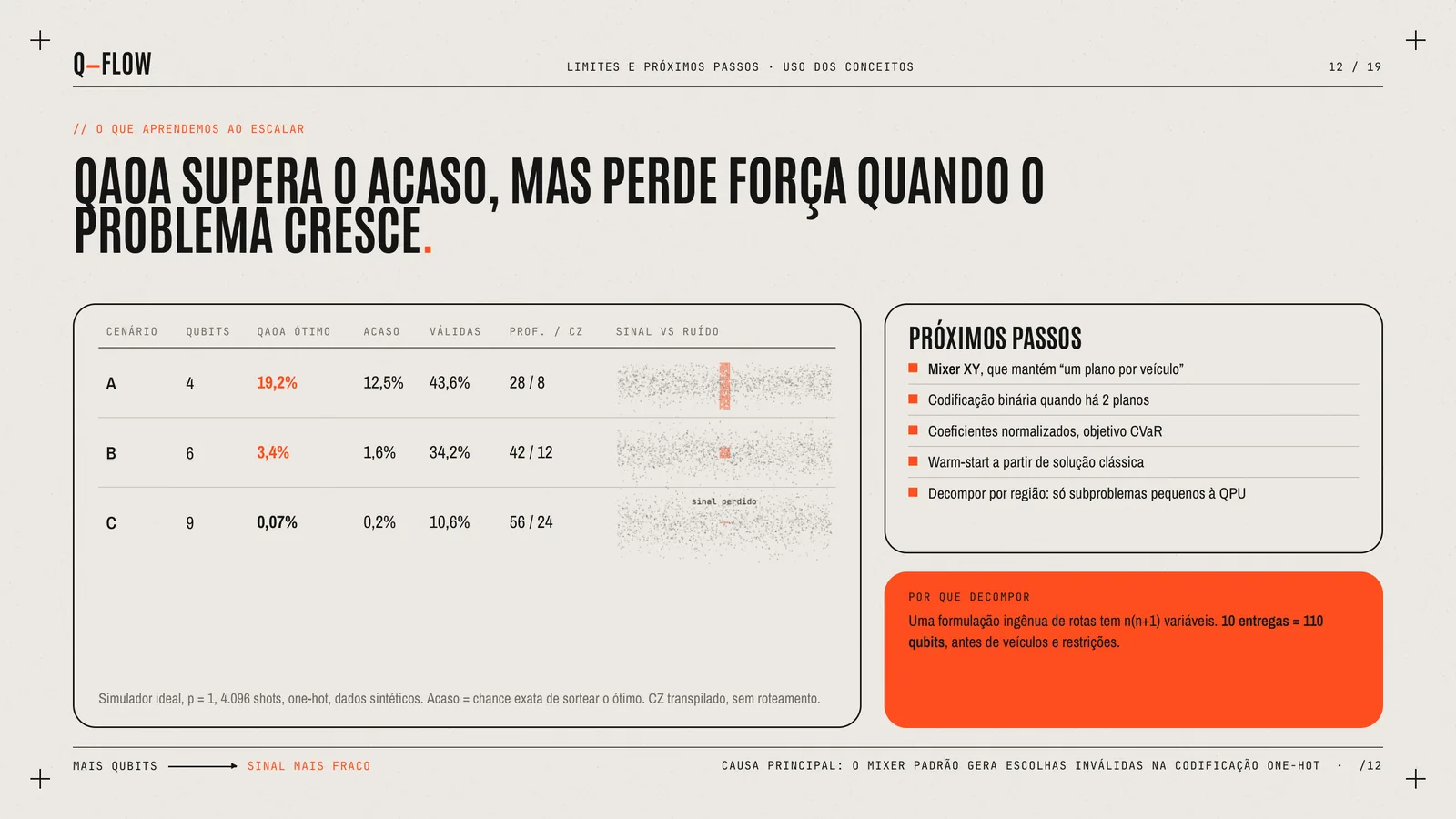
Scaling up: QAOA beats chance, but loses strength as the problem grows
Pitch Decisions
Carriers already run their operation on a TMS and will not swap it for an experimental technology. Q-Flow reads orders, fleet and deadlines from the TMS and sends back a recommended plan, with its estimated cost, the constraints it checked and the solver it used.
A new platform the carrier would have to adopt
A layer that plugs into the system already in place
With a classical fallback, the operation never depends on a quantum computer being available. Q-Flow sells decisions, not quantum computing time.
QUBO and Ising Hamiltonians mean little to most of the audience. The pitch explains the method with two trucks and two routes, where congestion adds R$ 70 if both take route A, and only then shows the cost function and the circuit.
Formulas first, intuition later
Two trucks that carry the whole method
Each step, from binary variables to the QAOA circuit, points back to the same case: deciding alone costs R$ 660, coordinating costs R$ 610.
A run on real quantum hardware invites overclaiming. The narration says plainly that this is not quantum advantage but proof that the pipeline works end to end, and the slides flag the R$ 50 saving as illustrative.
The numbers stay credible for a technical jury, and the slide on scaling limits becomes part of the story instead of a weak spot.
The identity follows the narrative: grainy noise for scattered decisions, an orange line for the coordinated plan, and black chapter cards that close each part of the video.
The same metaphor connects the opening line, every slide and the closing frame.
The video had fixed chapters of 11 to 40 seconds. Each sentence starts when its subtitle appears, long pauses were tightened, and lines the script marked as optional were cut so every chapter ends before its transition.
Voice, subtitles and slides stay in sync for the full 2:54.
What the Team Measured
Proof-of-concept runs by the team on November 25, 2026, as reported in the pitch.
- IBM Kingston, two-truck example: 96.5% of 4,096 shots landed on an optimal solution, against 50% by chance
- IBM Fez, real São Paulo to Santos route with delay risk from the Jev API: 91.9% on the optimal decision, against 25% by chance
- In simulation, the signal faded as the problem grew from 4 to 9 qubits, which shaped the next steps
These runs show the pipeline working end to end on real hardware. They do not show quantum advantage.
Key Takeaways
- •A technical idea needs one concrete example before any formula. Two trucks explained more than the Hamiltonian did.
- •Being clear about limits builds trust. Saying "this is not quantum advantage" made the real result easier to believe.
- •The near future of quantum computing is hybrid: classical systems shrink the problem, and the quantum part handles only the hard combinatorial core.
Seeing a circuit from our team return the right answer on a real IBM processor turned quantum computing from distant theory into a tool under construction, with clear limits and real potential for decisions that are still made one at a time, like the logistics that keep a country moving. Helping tell that story was one of the most rewarding projects I have worked on.
Q-Flow is a student project. It does not represent institutional approval by IBM or FIAP.
Future Improvements
- XY mixer, so every candidate keeps one plan per vehicle
- Split the problem by region and send only small subproblems to the quantum computer
- Benchmark against an industrial classical solver
- Shadow-mode pilot with a carrier: recommend plans without changing real decisions
Previous Project
Elo SaúdeNext Project
Vancouver Service Jam